
Is Print on Demand Sustainable? The Honest 2026 Guide
Table of Contents
- How Print on Demand Cuts Waste and Overproduction
- Eco-Friendly Print on Demand UK: What Actually Makes a Difference
- Sustainable Art Print Production: Paper, Inks and Printing Methods
- Print on Demand Supply Chain Transparency: Asking the Right Questions
- Shipping, Fulfilment Centres and Carbon Footprint
- The Greenwashing Trap: Spotting Claims That Don't Hold Up
- What Happens at End of Life: Garment Longevity and Circular Economy
- So, Is Print on Demand Sustainable? The Verdict
- Frequently Asked Questions
Last Updated: September 24, 2026
How Print on Demand Cuts Waste and Overproduction
Ask whether print on demand is sustainable and the honest answer starts with a simple structural fact: nothing gets printed until someone orders it. Traditional retail runs on speculative inventory, where a brand guesses demand months ahead, prints thousands of units, and writes off whatever doesn't sell. Print on demand flips that model. At Drift and Cast, every poster is produced only after a customer clicks buy, which means no dead stock and no landfill-bound overruns.

Speculative Inventory vs On-Demand Production
Speculative inventory is the practice of producing goods before demand is confirmed. It drives waste at every stage: unsold garments get discounted, shipped, or destroyed; storage adds energy costs; and forecasting errors compound. On-demand production removes the guesswork entirely. One order, one print, one shipment.
The Limits of the Waste Reduction Argument
Print on demand is not automatically green. A single-item print still consumes paper, ink, energy, and shipping fuel. The waste reduction is real, but it only addresses one part of the environmental impact. The rest depends on materials, inks, fulfilment, and how long a product actually lasts.
Eco-Friendly Print on Demand UK: What Actually Makes a Difference
An eco-friendly print on demand operation in the UK is defined by its inputs and its transparency, not its marketing language. Three factors separate genuine sustainability from surface-level claims: the paper or fabric used, the ink chemistry, and whether the supply chain can be traced.
Certifications Worth Checking
Certifications are useful because they shift a claim from assertion to audit. Each one covers a different part of the chain, so a genuinely sustainable product usually carries more than one.
- FSC (Forest Stewardship Council): verifies responsible forest sourcing for paper and card. It applies to the fibre, not the printing process, so it says nothing about inks or energy.
- GOTS (Global Organic Textile Standard): confirms organic fibre content in apparel and also sets limits on chemical inputs and wastewater treatment during processing. It is a textile standard, not a paper one.
- OEKO-TEX: tests for harmful substances in textiles. The Standard 100 label applies to the finished article, while the Made in Green label adds supply chain and social criteria.
- Soil Association: UK-based organic certification for textiles and materials, widely recognised in food and increasingly in fibre.
- PEFC (Programme for the Endorsement of Forest Certification): an alternative forest certification scheme that endorses national schemes, often found on paper where FSC is not used.
- Cradle to Cradle Certified: assesses material health, circularity and renewable energy across a product, rather than a single input.
What Certifications Don't Tell You
A certification is a floor, not a ceiling. FSC paper can still be printed with solvent inks and shipped by air. GOTS cotton can still be cut and sewn in a facility powered by coal. The most common gap is energy: almost no mainstream certification covers the electricity source at the fulfilment centre, which is often the single largest operational emission in a print on demand setup.
The Materials Trade-Off Nobody Mentions
Every 'eco' material choice involves a trade-off, and pretending otherwise is where most content loses credibility.
- Recycled paper vs virgin FSC paper: recycled stock diverts waste from landfill and typically uses less energy and water, but it can be darker and less consistent, which matters for fine art reproduction. Virgin FSC paper gives better colour fidelity at a higher land-use cost.
- Organic cotton vs conventional cotton: organic cotton avoids synthetic pesticides and uses less water in growing, but yields are lower, so it can carry a higher price and, in some cases, a higher land footprint per garment.
- Recycled polyester vs virgin polyester: recycled polyester reduces reliance on new fossil feedstock, but it still sheds microplastics in the wash and is not biodegradable. It is a lower-impact version of a problematic material, not a solution.
- Bamboo and hemp: both grow quickly with low inputs, but the fibre often needs chemical processing to become soft fabric, so the sustainability depends heavily on the mill.
Sustainable Art Print Production: Paper, Inks and Printing Methods
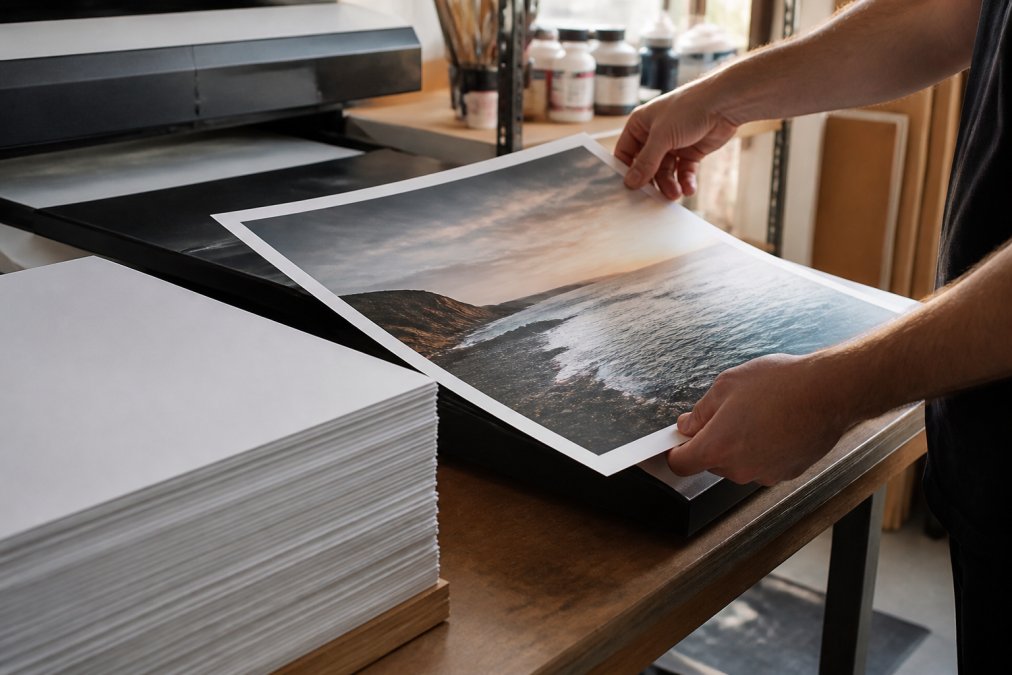
Sustainable art print production comes down to three choices: the paper, the ink, and the printing method. Get those right and the environmental impact drops sharply. Get them wrong and no amount of offsetting fixes it.
Water-Based Inks and Non-Toxic Chemicals
Water-based inks use water as the carrier rather than petroleum-derived solvents. That means fewer volatile organic compounds released during printing, and no heavy metals leaching from the finished product. Non-toxic chemicals matter for the same reason: a poster that hangs in a child's bedroom shouldn't be off-gassing anything.
Print on Demand Supply Chain Transparency: Asking the Right Questions
Supply chain transparency is the difference between a claim and a verifiable fact. Any print on demand sustainable operation should be able to answer four questions without hesitation:
- Where are your fulfilment centres located?
- What energy source powers them?
- Who supplies your paper and fabric, and are they certified?
- How is waste managed at each production site?
Shipping, Fulfilment Centres and Carbon Footprint
Shipping is often the largest single contributor to a print on demand product's carbon footprint. Air freight, long-haul road transport, and single-item packaging all add up. The mitigation strategies that actually work are local fulfilment, consolidated shipping, and plastic-free packaging. A print produced and shipped from a fulfilment centre in the same region as the buyer carries a fraction of the emissions of one flown in from another continent.
"What's Down There?" – Underwater →
The Greenwashing Trap: Spotting Claims That Don't Hold Up
Greenwashing is the practice of making environmental claims that sound impressive but lack substance. In print on demand, it shows up in phrases like "planet-friendly," "eco-conscious," or "sustainable by design" with no certification, no data, and no supply chain detail behind them. Watch for these red flags:
- No named certifications (FSC, GOTS, OEKO-TEX)
- Sustainability claims with no supporting evidence
- "Carbon neutral" without a stated methodology
- Vague terms like "natural" or "green" used as product descriptions
What Happens at End of Life: Garment Longevity and Circular Economy
Most sustainability content stops at the point of sale. That is a mistake, because for many printed products the end-of-life stage carries a meaningful share of the total impact, and it is the stage a buyer has the most control over.
Why Longevity Beats Production Claims
The most sustainable product is the one you keep using. A poster that fades in a year has a worse footprint than a well-made item that lasts a decade, because the production impact is spread across far fewer viewings. This is the core of the circular economy argument: durability, repairability and reuse reduce the need for replacement, and replacement is what drives new production.
- Ink durability: water-based pigment inks cured properly resist fading better than poorly cured alternatives. A print that fades in sunlight is a print that gets replaced.
- Substrate quality: heavier, acid-free paper resists yellowing; cheap coated stock does not.
The End-of-Life Problem Print on Demand Doesn't Solve
On-demand production eliminates dead stock, but it does not eliminate the product itself. Every printed item eventually reaches the end of its useful life, and the options at that point are limited:
- Paper and card recycling: posters and packaging are among the easier materials to recycle, provided they are not laminated, foiled or heavily coated. Mixed-material finishes are the main contaminant.
What to Ask a Print on Demand Provider About End of Life
Because end-of-life infrastructure is patchy, the practical question is not 'is this product recyclable in theory' but 'what does the provider actually support'. Useful questions include:
- Are packaging materials kerbside-recyclable in the UK, or do they require a specialist stream?
- Does the provider offer or partner with a take-back or repair scheme?
- Are products designed for disassembly, so mixed materials can be separated?
- Is there any published guidance on how to recycle or dispose of the item responsibly?
The Unique Angle: Design for Longevity, Not Just Low Impact
Most sustainability advice for print on demand focuses on reducing impact per unit. A stronger framing is to design for longevity from the start: choose inks and substrates that survive years of use, avoid finishes that make recycling impossible, and give customers the information they need to keep the product in use for as long as possible.
So, Is Print on Demand Sustainable? The Verdict
Print on demand is more sustainable than traditional speculative inventory, but it is not automatically sustainable. The waste reduction from on-demand production is genuine. Whether the final product is truly eco-friendly depends on the paper, the inks, the fulfilment energy, the shipping distance, and how long the item lasts.
| Factor | Traditional Inventory | Print on Demand |
|---|---|---|
| Overproduction risk | High | None |
| Waste from unsold stock | Significant | Minimal |
| Paper/fabric choice | Varies | Can be FSC/GOTS certified |
| Ink chemistry | Often solvent-based | Water-based available |
| Shipping footprint | Bulk, then redistribution | Single-item, local fulfilment preferred |
| End-of-life impact | Depends on durability | Depends on durability |
Frequently Asked Questions
Is print on demand more sustainable than traditional bulk manufacturing?
In most cases, yes. Traditional bulk manufacturing produces speculative inventory, so unsold stock often ends up discounted, warehoused or destroyed. Print on demand makes each item only after it is ordered, which removes most of that overproduction. The sustainability advantage is real but not automatic: it depends on the inks, paper, packaging and delivery distances involved. A print on demand item made with water-based inks on FSC-certified paper and shipped from a nearby fulfilment centre will outperform a bulk-produced equivalent on waste, energy and emissions.
What certifications should I look for in sustainable art print production?
The most useful certification for paper and card is FSC, which confirms the fibre comes from responsibly managed forests. For textiles, look for GOTS or OEKO-TEX, which cover organic content and restricted substances. For inks, ask whether they are water-based and free from heavy metals. A brand that names these standards on its product pages is easier to trust than one that only uses the word eco-friendly. If a supplier cannot say which certification applies, treat the claim as unverified.
How does print on demand reduce textile and paper waste?
Print on demand only produces an item once a customer has bought it, so there is no pile of unsold stock to dispose of at the end of a season. In traditional retail, a significant share of printed apparel and posters is never sold and is either discounted, incinerated or sent to landfill. On-demand production also lets a design stay available indefinitely rather than being printed in a fixed batch, which means fewer rushed reprints and less spoilage from storage damage, damp or handling.
How do eco-friendly inks and materials impact print quality?
Water-based inks have improved considerably and now deliver strong colour and fine detail on both matte and semi-glossy papers. On textiles, they sit in the fabric rather than on top of it, so prints feel softer and tend to hold up well through repeated washing. The main trade-off is that some water-based inks need careful curing, so production quality varies between suppliers. Choosing a printer that specifies its paper weight, such as 170 gsm or 200 gsm, and its ink type gives you a clearer idea of what will arrive.