
Why Are Art Prints Expensive? The Real Costs
Table of Contents
- Why Are Art Prints Expensive? Breaking Down the Costs
- Materials: Paper, Inks, and Archival Quality
- Labour and Artistic Skill
- The Fine Art Giclée Printing Process Explained
- Limited Edition vs Open Edition Prints: What Drives the Price Up
- The Hidden Logistics Costs Behind Art Prints
- Print-on-Demand vs Studio-Produced: Which Affects Cost More?
- Best Print on Demand Suppliers for Professional Artists
- Sustainability and Ethical Sourcing in Art Printing
- Frequently Asked Questions
Last Updated: October 1, 2026
Why Are Art Prints Expensive? Breaking Down the Costs
A fine art print can cost several times more than a mass-market poster of the same size, which is why art prints expensive is a question buyers keep asking, and the gap is not marketing noise. It reflects what goes into the sheet: archival materials, pigment inks, skilled labour, and the logistics of moving flat, fragile objects without damaging them.

Materials: Paper, Inks, and Archival Quality
The single biggest driver of cost is archival quality. Acid-free paper with a neutral pH resists the yellowing and brittleness that ruins cheap prints within a few years, and costs meaningfully more than standard stock.
Labour and Artistic Skill
Printing is the last step, not the first. Before a single sheet runs, someone scouts the location, waits for the right light, shoots, edits, and proofs the file. That labour is invisible in the final product but sits in the price.
The Fine Art Giclée Printing Process Explained
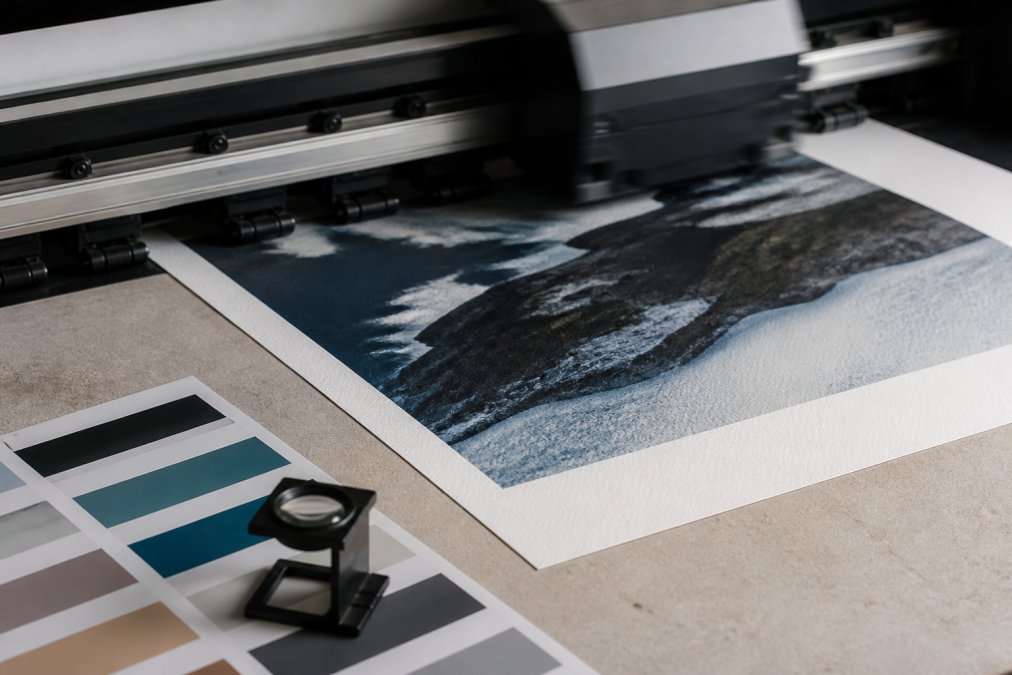
Fine art giclée printing is a pigment-based inkjet process that lays down microscopic droplets of ink at very high resolution onto archival media. The word "giclée" comes from the French for "to spray," and the process separates a fine art reproduction from a standard office print.
Pigment Inks vs Dye Inks: Why It Matters
Pigment inks are the reason giclée prints cost more. Dye inks sit in the paper coating and fade comparatively fast under light; pigment particles sit on the surface and resist UV degradation far longer. A dye-based print might look vivid on day one and washed out in a few years.
Colour Gamut and Accuracy
Colour gamut is the range of colours a printer can reproduce, and a 12-colour giclée system covers a wider gamut than a standard 4-colour process. That range holds the subtle gradations in a seascape: steel-grey water versus green-grey water. Colour accuracy is verified through proofing, and every proof costs time and materials.
Limited Edition vs Open Edition Prints: What Drives the Price Up
A limited edition print is capped at a fixed print run, numbered and often signed, which creates scarcity and a documented provenance. An open edition has no cap and can be reprinted indefinitely.
| Print type | Run size | Numbered | Price driver |
|---|---|---|---|
| Limited edition | Fixed, often small | Yes | Scarcity, provenance, signature |
| Open edition | Unlimited | No | Volume, materials, convenience |
The economics of licensing: where the money actually goes
This is the part buyers rarely see, and the most direct answer to "why is it so expensive?" A print sold through a gallery, marketplace, or licensing platform is not priced at cost-plus-margin. It is priced to support a chain of participants, each taking a cut.
- Platform or gallery commission, commonly 30-50% of the retail price, sometimes more for physical gallery representation with framing and hanging costs.
- Payment processing, a small percentage plus a fixed fee per transaction.
- Production and materials, paper, ink, proofing, and print time.
- Packaging and shipping, a real per-unit cost.
- Marketing and customer acquisition, advertising, email, social, and the cost of getting a stranger to the product page.
- The artist's share, whatever remains, which on a low-priced open edition can be surprisingly thin.
Why limited editions are priced higher, and why that is not gouging
A limited edition carries costs an open edition does not:
- Numbering and signing, physical handling time per print, plus the risk of a mis-numbered or damaged signed sheet.
- Documentation, a certificate of authenticity, often printed on matching stock, sometimes with a holographic or embossed element.
- Proofing and approval, the artist typically signs off a proof before the run, and that proof is a sunk cost spread across a small number of sales.
- Unsold risk, if the edition does not sell out, the studio has already paid for the whole run and cannot recoup by printing more.
Print-on-demand vs studio-produced: the price delta explained
A related confusion is why two prints of the same size and similar paper can differ sharply in price. The answer is usually the production model.
- Print-on-demand (POD), the print is produced only after an order is placed, often by a third-party fulfilment partner. There is no stock, no warehousing, and no unsold inventory. The trade-off is a higher per-unit print cost, less control over paper and ink, and packaging chosen by the fulfilment partner rather than the artist.
- Studio-produced, the artist or studio prints in batches, controls the paper, ink, proofing, and packaging, and can guarantee colour consistency across reprints. The trade-off is upfront capital, storage, and the risk of dead stock.
What this means for the price you pay
A limited edition is not expensive because it is rare. It is expensive because it is rare, documented, signed, proofed, insured against unsold risk, and sold through a channel that takes a commission. Strip any of those away and the price falls, along with the collector value.
The Hidden Logistics Costs Behind Art Prints
Logistics is the cost nobody itemises, and where margins quietly disappear. Prints are flat, light, and easily creased, making them awkward and expensive to ship relative to their weight. A 250 gsm A2 sheet weighs very little, but it is a large, rigid, damage-prone object, and couriers price those by volumetric size and handling class, not by the number on the scales.
Packaging: the layers that actually protect a print
A print cannot simply go in an envelope. A studio-grade mailer typically stacks four or five separate components, each of which costs money and adds weight:
Kynance Cove, The Lizard, Cornwall →
- Rigid backing board (often 2-3 mm acid-free greyboard or corrugated) to stop the sheet flexing.
- A protective sleeve, usually a glassine or acid-free tissue interleaf against the print surface, then a clear poly or biodegradable sleeve.
- Corner protection, rigid corner boards or foam inserts, because corners are the first thing to crush.
- An outer mailer, a flat rigid envelope for smaller sizes or a wide-bore tube for anything above roughly A2.
- Moisture barrier, a poly outer bag or coated mailer, because paper that takes on damp in transit cockles and is effectively unsellable.
Flat vs tube: the trade-off nobody explains
Studios face a genuine dilemma here, and it is worth understanding because it directly affects what you receive.
| Method | Cost profile | Risk | Buyer experience |
|---|---|---|---|
| Flat rigid mailer | Higher volumetric weight, higher postage | Lower creasing risk if board is stiff enough | Arrives ready to frame |
| Tube | Lower volumetric weight, cheaper postage | Lower crease risk, higher curl risk | Needs flattening under weight for days |
Insurance, tracking, and the true cost of a claim
Couriers treat art prints as a higher-risk category. That shows up in three ways:
- Insurance surcharges on declared value, which rise with the print's price.
- Signature and tracking requirements, which push the shipment into a more expensive service tier.
- Claim administration, even when a courier pays out, the studio has already spent time on photographs, forms, and a replacement print.
Returns and the asymmetry of the deal
Distance-selling rules in the UK give consumers a statutory right to cancel most online orders within 14 days of delivery and return the goods, with the trader generally refunding standard outbound delivery costs (Accepting returns and giving refunds: the law). For a studio, a returned print is not simply "back in stock":
- The packaging is destroyed and must be replaced.
- The print may have picked up handling marks and cannot always be resold as new.
- The studio has paid outbound postage, return postage (in many cases), and staff time.
Why this matters to the price you pay
The honest summary: a fine art print is not priced like a book or a T-shirt. It is priced like a fragile, oversized, insured, tracked, occasionally-returned object that has to arrive flat and unmarked. Every one of those adjectives adds cost before the print reaches the frame.
Print-on-Demand vs Studio-Produced: Which Affects Cost More?
Print-on-demand means each item is printed only after it is ordered, removing warehousing and unsold stock but raising the per-unit print cost. Studio-produced runs are cheaper per unit at volume but require upfront capital and storage.
Best Print on Demand Suppliers for Professional Artists
The best print-on-demand suppliers for professional artists are those that offer archival papers, pigment-based inks, and a wide size range without forcing you into minimum orders. The criteria that matter most are paper specification, ink type, colour consistency across reprints, and packaging quality.
Sustainability and Ethical Sourcing in Art Printing
Sustainable print production centres on two things: where the paper comes from and how much is wasted. FSC-certified paper addresses the first. Print-on-demand addresses the second by producing only what is ordered, avoiding the landfill-bound overstock that plagues bulk runs.
Frequently Asked Questions
What is the difference between a mass-produced poster and a fine art print?
Mass-produced posters use standard inks and lightweight paper, often fading within months. Fine art prints use pigment-based inks and acid-free paper, delivering colour accuracy and longevity. For example, a giclée print on 200 gsm FSC-certified paper will resist yellowing for decades, while a cheap poster may discolour in a year. That's why art prints cost more.
How does paper quality affect the price of an art print?
Paper weight (gsm) and composition matter. Archival papers like 250 gsm acid-free matte cost significantly more than standard 170 gsm glossy. They prevent yellowing and maintain colour fidelity. For instance, Drift and Cast's Winter Fishing print uses 250 gsm acid-free paper, which adds to the cost but ensures the print lasts a lifetime.
Why do limited edition prints cost more than open editions?
Limited editions have a fixed print run, often numbered and signed, creating scarcity and potential investment value. Open editions can be reprinted indefinitely, so they lack exclusivity. The artist's labour in creating and proofing a limited run, plus the smaller volume, drives up the per-unit price. This is a key reason art prints are expensive.
What are archival inks and why do they increase print costs?
Archival inks are pigment-based, not dye-based, so they resist fading and colour shift. They cost more because the pigments are more expensive and the printing process requires precise colour management. For example, a 12-colour giclée printer uses multiple pigment inks to achieve a wider colour gamut, which raises production costs compared to standard four-colour printing.
Art prints cost what they cost because every stage, from the shoot to the mailer, is built to protect the image for decades rather than months. If you want coastal work made to that standard, explore the Drift and Cast collection: 12-colour giclée printing, FSC-certified archival papers, and sustainable print-on-demand production, all inspired by the Cornish coast. Shop the collection and bring a piece of the shoreline home.