
Coastal Lifestyle Company Alternatives Worth Buying in 2026
Table of Contents
- Why Look Beyond Big Coastal Lifestyle Companies?
- Quick Comparison: Coastal Lifestyle Company Alternatives at a Glance
- Sustainable Coastal Homeware UK: Where Quality Meets Ethics
- Modern Coastal Interior Design Tips for an Authentic Feel
- Cornish Inspired Home Decor: A Case Study in Craftsmanship
- Splurge Versus Save: Price-to-Quality Ratios Explained
- Common Coastal Decor Mistakes to Avoid
- Final Thoughts on Choosing Your Coastal Alternative
- Frequently Asked Questions
Last Updated: September 9, 2026
The coastal interiors market has grown crowded with big lifestyle brands selling the same mass-produced driftwood ornaments and generic "Live Laugh Sail" prints. Yet most of these coastal lifestyle company alternatives fail to capture what actually makes a coastal home feel authentic: the specific textures, tones, and stories of a particular stretch of shoreline. At Drift and Cast, we believe the difference comes down to whether a brand designs from a genuine place of coastal observation or simply follows a trend checklist. The best coastal lifestyle company alternatives focus on craftsmanship, sustainable sourcing, and designs rooted in real coastal landscapes rather than generic beach-themed decor. Below, we'll show you exactly how to identify these quality alternatives and build a coastal living room that feels layered and lived-in, not decorated by a catalogue.
Why Look Beyond Big Coastal Lifestyle Companies?
Large coastal brands often prioritise volume over authenticity, which is why their nautical accents and scallop-patterned cushions tend to look identical across thousands of homes. When you buy from a coastal lifestyle company that produces at scale, you are typically paying for branding and distribution rather than design originality or material quality. A common approach among independent makers is to work in smaller batches, using natural fibers and weathered finishes that actually improve with age instead of cheap synthetic alternatives that fade within a season.
The durability question matters more than most shoppers realise, particularly for homes in humid coastal environments where salt air and moisture test everything from jute rugs to linen upholstery. Independent coastal brands often make different material choices because they design for the conditions they live with daily, not for a warehouse in a dry inland distribution centre.
Quick Comparison: Coastal Lifestyle Company Alternatives at a Glance
A simple list of shop types doesn't help you make a smart purchase. The real question is what you get for your money at each price tier, and how that build quality holds up in a humid, salt-laden environment. The table below breaks down the actual trade-offs you'll encounter when comparing independent coastal brands against high-street retailers and marketplace sellers.
| Option | Price Range (Typical Item) | Build Quality & Materials | Durability in Coastal Homes | Sustainability Profile | Best For |
|---|---|---|---|---|---|
| Independent Cornwall-inspired brands (e.g., Drift and Cast) | £15-£25 per item | Enamel over steel core, stainless steel, or high-gsm art paper; print is fused or coated, not just applied to the surface | High, enamel resists rust and chipping; stainless steel handles salt air without corroding; prints are fade-resistant | Print-on-demand eliminates overstock waste; materials are chosen for longevity, not trend cycles | Authentic, place-specific art and drinkware that will last through daily use and repeated washing |
| High-street coastal retailers (e.g., national homeware chains) | £10-£40 per item | Often ceramic with a glossy coating, or synthetic fabrics like polyester blends; 'driftwood' is frequently MDF with a printed wood grain | Variable, ceramic can chip; synthetic fabrics degrade and fade in direct sunlight; MDF swells in humidity | Limited transparency; mass production leads to surplus stock and markdowns | Budget-friendly decor where visual effect matters more than longevity |
| Marketplace sellers (e.g., Etsy, eBay, Not on the High Street) | £5-£30 per item | Unpredictable, you might find solid reclaimed teak or a resin copy of a shell; read material listings carefully | Unpredictable, reclaimed wood can be excellent if properly sealed; resin and plastic will yellow and become brittle | Mixed, some sellers upcycle, others ship cheap imports; check individual shop policies | One-off finds, vintage pieces, and reclaimed treasures with genuine character |
| Direct-from-artist prints (e.g., independent illustrators) | £20-£60 per item | Giclée prints on archival paper or canvas; often limited editions | Medium, paper needs framing behind glass to protect from humidity; canvas can sag in damp conditions | Low-volume production is inherently less wasteful; artists often use certified sustainable paper sources | Unique wall art that carries a specific coastal narrative |
How to Read This Table for Your Home
If you live within a mile of the coast, the durability column should outweigh the price column. A £12 marketplace resin ornament might look fine in a dry inland living room, but in a seaside town it will start to discolour within a year (the NIH). The independent enamel and stainless steel options at £15-£25 are priced to reflect materials that are genuinely engineered for coastal conditions. The trade-off is that you cannot walk into a shop and feel the fabric or the weight of the piece first. You rely on detailed material descriptions and honest product photography instead, which is why the next section on what to look for in a brand is critical.
What to Look For in a Coastal Brand
Before committing to a purchase, check whether the brand openly states its materials, production process, and design inspiration. Brands that genuinely care about coastal aesthetics will tell you exactly where their imagery comes from, whether that is a tidal estuary, a fishing boat texture, or a specific stretch of Cornish coastline. Vague descriptions like "ocean-inspired" without any specific reference point usually signal generic design. Look for three specific signals: a named material (e.g., "vitreous enamel on steel" rather than just "enamel"), a stated production method (e.g., "print-on-demand in the UK" rather than "imported"), and a specific geographic or cultural reference point in the design story.

Sustainable Coastal Homeware UK: Where Quality Meets Ethics
Sustainable coastal homeware UK shoppers face a particular challenge: the most beautiful natural-fibre pieces often travel thousands of miles, and the carbon cost undermines the ethical intention. The solution is to prioritise brands that produce domestically or use print-on-demand models, which avoid the waste of pre-manufactured surplus stock. A coastal lifestyle company operating this way produces each piece only after you order it, meaning no unsold inventory ends up in landfill.
Material transparency is the second pillar of ethical sourcing. Look for jute, seagrass, and organic cotton that are certified or at least clearly described by the supplier. For drinkware and kitchen items, enamel and stainless steel offer genuine durability advantages over plastic alternatives, and they can be handed down rather than thrown away (the EPA). According to guidance on sustainable consumption from the UK government, choosing longer-lasting products is one of the most effective ways households can reduce their environmental footprint.
Modern Coastal Interior Design Tips for an Authentic Feel
Modern coastal interior design tips often get reduced to "paint everything white and add rope," which produces spaces that feel sterile rather than serene. The authentic approach starts with a neutral color palette drawn from the specific shoreline you love, whether that is the grey-green of Atlantic water, the warm sand of a sheltered cove, or the deep blue of a fishing harbour at dusk. Build the room around these tones rather than generic blues and whites.
Light and bright interiors work best when balanced with darker, grounding elements. A slouchy linen sofa in oatmeal provides the relaxed foundation, while a dark timber side table or a charcoal ceramic vase adds the contrast that prevents the room from feeling washed out. This textural layering is what separates a considered coastal living room from a beach-themed decor showroom.
Texture and Tone: Building a Layered Look
The secret to a layered coastal interior is mixing at least three distinct textures within every sightline. Pair a flat-weave jute rug underfoot with the soft grain of wicker and rattan furniture, then add the cool, smooth surface of a ceramic or enamel piece at table height. Driftwood aesthetics work best as accent pieces rather than the main event, and seaweed motifs or scallop patterns should appear sparingly in cushions or art rather than across every surface.
Cornish Inspired Home Decor: A Case Study in Craftsmanship
Cornish inspired home decor offers a masterclass in why place-specific design outperforms generic coastal styling. The rugged Atlantic coastline, the working fishing harbours, and the tidal estuaries of the region provide a visual vocabulary that cannot be replicated by brands designing from a city studio. A coastal lifestyle company drawing on this heritage produces pieces with genuine narrative depth, whether that is a print of a fishing boat's weathered hull or a mug decorated with the day's catch.
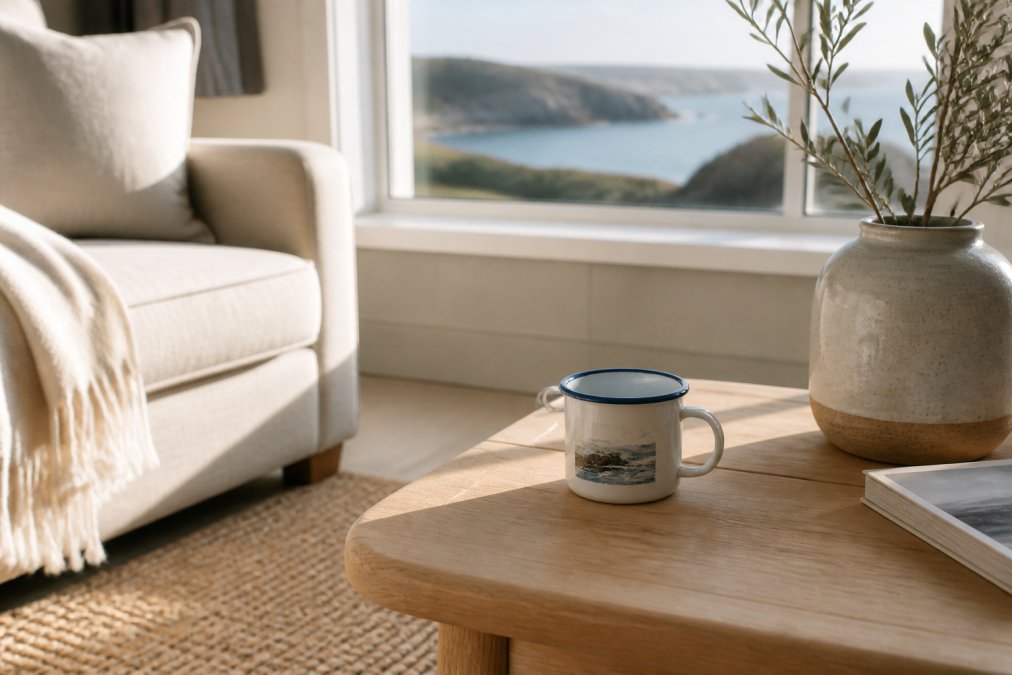
For a practical example of this craftsmanship, consider the Drift & Cast Enamel Mug - Coastal Style, 12oz at £15.99. This lightweight enamel mug carries its coastal identity through print design rather than shape, making it versatile enough for a camping trip or a styled kitchen shelf. The Bluefin Tuna Travel Mug - Leak-Proof, 15oz at £21.99 offers a different take, using a stainless steel body that keeps drinks at temperature while the vibrant marine-life print adds character to a commute. Both pieces demonstrate the principle that coastal design works best when it is specific about its subject matter.

Splurge Versus Save: Price-to-Quality Ratios Explained
Understanding price-to-quality ratios in coastal decor comes down to one question: are you paying for materials and design, or for a logo? A £16 enamel mug from an independent brand and a £30 mug from a high-street retailer may look similar in photographs, but the difference lies in the durability of the print, the quality of the enamel coating, and whether the design has genuine artistic merit. The independent coastal lifestyle company alternative typically wins on this ratio because it spends on production rather than retail overheads.
Splurge versus save decisions should follow a clear hierarchy. Splurge on pieces that touch your skin or hold your food and drink, because material quality directly affects your experience. Save on decorative items where visual effect matters more than tactile quality. A jute rug and linen upholstery justify investment. A driftwood ornament from a marketplace seller at a fraction of the price delivers the same visual effect.
Common Coastal Decor Mistakes to Avoid
The most frequent mistake in coastal styling is overloading a room with obvious nautical accents. Anchors, ship wheels, and rope-framed mirrors create a theme-park effect rather than a sophisticated coastal aesthetic. A coastal lifestyle company alternative that succeeds will use these elements sparingly, if at all, preferring subtle references like a scallop edge on a cushion or the muted tones of a seaweed-inspired print.
The second common error is ignoring scale and proportion. A tiny shell arrangement lost on a large coffee table, or an oversized wall print overwhelming a small living room, both disrupt the balance of the space. Measure your walls and surfaces before buying wall decor, and group small coastal homewares in clusters of three or five for visual impact. The third mistake is neglecting the practical demands of coastal living, where humidity and salt air require materials that resist moisture and fading. Synthetic fabrics and untreated woods will deteriorate quickly in these conditions, making durable natural materials the smarter long-term investment.
Final Thoughts on Choosing Your Coastal Alternative
Choosing the right coastal lifestyle company alternative ultimately comes down to values alignment. You are deciding whether to support a brand that designs from genuine coastal observation, produces sustainably, and builds durable pieces, or one that simply sells the aesthetic without the substance. The best alternatives combine artistic integrity with practical durability, offering pieces that work as hard as they look good.
Finding a coastal brand that balances authenticity, sustainability, and durability takes research, but the payoff is a home that genuinely reflects the wild, salt-aired places you love. Drift and Cast brings the Cornish coast into your space through premium art prints, durable enamel and stainless steel drinkware, and home decor designed to evoke the stillness of tidal estuaries and the texture of working fishing boats. Every piece is produced on demand to minimise waste. Shop the collection and bring the spirit of the shoreline into your home.
Frequently Asked Questions
What makes an independent coastal brand different from a large coastal lifestyle company?
Independent brands often focus on specific regional aesthetics, like Cornish inspired home decor, rather than mass-market trends. They typically produce smaller batches, which allows for better quality control and more distinctive designs. You are also more likely to find sustainable coastal homeware UK options that use ethical sourcing. Large companies may offer lower prices, but independent brands provide a direct connection to the artist and the place that inspired the work.
How can I achieve a modern coastal look without generic beach decor?
Skip the literal seashells and anchors. Modern coastal interior design tips focus on texture and colour. Use natural fibres like jute and linen, choose a neutral colour palette inspired by sand and stone, and pick furniture with weathered finishes. Incorporate nautical accents sparingly, such as a single piece of driftwood art or a mug with a fish print. The goal is to evoke the coast through materials, not souvenirs.
Where can I find sustainable coastal homeware in the UK?
Look for brands that are transparent about their production. Many independent UK brands use print-on-demand services to reduce waste, meaning items are only made when ordered. Check what materials are used; for example, enamel mugs are durable and long-lasting, while stainless steel flasks are recyclable. Supporting a small business like Drift and Cast, which focuses on Cornish landscapes, often means your items are produced closer to home, cutting down on shipping emissions.
Are higher-priced coastal pieces from independent brands worth the cost?
Often, yes. The price difference reflects the design work and the quality of the base product. A £15.99 enamel mug from an independent brand is not just a printed cup; it is a durable item. Cheaper alternatives may fade or chip quickly. When you compare price-to-quality ratios, investing in a piece that withstands daily use and washing often saves money in the long run.