
Coastal Wall Art for Living Room: 2026 Styling Guide
Table of Contents
- Why Coastal Wall Art for Living Rooms Goes Beyond Beach Clichés
- Quick Comparison: Coastal Wall Art Styles and Price Points
- Modern Coastal Living Room Decor: From Canvas to Framed Prints
- Coastal Colour Palettes for Interiors That Stay Serene, Not Souvenir-Like
- How to Choose Wall Art for Living Room Layouts and Wall Sizes
- Gallery Walls and Arrangement Ideas That Feel Curated
- Art Placement and Lighting: Making the Piece Work After Dark
- Sustainable Coastal Art and What to Ignore When Shopping
- Bringing the Coast Home with Intention
- Frequently Asked Questions
Last Updated: September 6, 2026
Choosing coastal wall art for living room spaces is about capturing the calm of the shoreline, not decorating with seashell clichés. At Drift and Cast, we design art rooted in the raw beauty of coastal landscapes and fishing culture.
Below, we break down how to select pieces that suit your wall size, palette, and lighting, and how to arrange them so your living room feels serene rather than souvenir-like.
Why Coastal Wall Art for Living Rooms Goes Beyond Beach Clichés
Coastal wall art taps into a psychological need for restoration and calm; water, open skies, and natural textures signal safety and relaxation (apa.org).
Literal motifs like anchors and lighthouses read as themed rather than curated. The most effective coastal wall art for living room schemes leans on subtlety, using muted tones, negative space, and organic forms to suggest the sea.
The goal is a backdrop for daily life, not a display case for holiday memories. Art capturing a specific moment brings authenticity generic prints cannot match.
Quick Comparison: Coastal Wall Art Styles and Price Points
The table below summarises common styles, typical starting prices, and where each works best.
| Style | Typical Starting Price | Material | Best For | Key Trade-Off |
|---|---|---|---|---|
| Canvas prints | From around £45 | Stretched cotton over FSC-certified wood frame | Statement pieces above a sofa | No glass means no glare, but the weave can catch dust; requires a deep frame profile (around 3-4 cm) to avoid a flimsy look |
| Framed art prints | From around £38 | Archival pigment on fine art paper, with a wood or metal frame | Gallery walls and layered arrangements | Glare from glass is a real issue in bright rooms; opt for anti-reflective glass or acrylic for south-facing windows |
| Watercolour giclée prints | From around £30 | Archival pigment on 300gsm cotton rag paper | Minimalist, calm interiors | The paper texture is part of the appeal, but it can buckle if not mounted properly; check if the print is mounted on a board or just taped |
| 3D wooden wall art | From around £120 | Layered natural wood, often oak or ash | Adding texture and depth to a blank wall | Heavier than framed prints, typically 5-10 kg, so you need a solid wall anchor; also, wood expands and contracts with humidity, so avoid damp exterior walls |
| Multi-piece sets | From around £25 | Lightweight framed prints, often with a thin aluminium or plastic frame | Quick, budget-friendly gallery walls | The frames are often non-replaceable and the prints are usually on thin paper; check if the set allows you to rearrange the pieces or if they are fixed in a single frame |
Prices vary with print quality, framing materials, and whether you buy from a marketplace or an independent studio.
Price per square metre of wall coverage is more useful than the sticker price. A single 120 cm canvas covers roughly 0.9 square metres, while a set of three 30 cm framed prints covers only 0.27 square metres. Above a 2-metre sofa, the single canvas is often the better value.
To avoid the environmental cost of shipping a bulky framed piece, consider unframed canvas rolls or flat-pack frames you assemble at home.
Know the difference between open and limited editions. Open editions are printed indefinitely, so they are unlikely to hold value but are fine for decor. Limited editions, typically numbered and signed, are priced higher because the artist caps the run at 50 to 150 prints.
Modern Coastal Living Room Decor: From Canvas to Framed Prints
Modern coastal living room decor has shifted from navy-and-white stripes toward an organic, earthy palette of oatmeals, driftwood greys, sage greens, and soft sand tones.
Canvas prints remain the most popular choice for large statement pieces. They have no glass to cause glare, making them ideal for bright rooms, and the weave adds a tactile quality flat paper cannot replicate.
Framed prints offer a more formal, curated finish, suiting gallery walls and smaller spaces.
The choice is also about how the piece behaves in your environment. Here is what category pages do not tell you:
Light reflection and viewing distance. A matte canvas scatters light, reading well from across a bright, south-facing room. A framed print under standard glass behaves like a mirror at certain angles, obscuring the image. If your sofa sits opposite a window, choose a canvas or specify anti-reflective (museum) glass when ordering a framed piece.
Humidity and temperature. Coastal homes, especially within a mile of the sea, experience higher humidity. Canvas is more forgiving because the fabric expands and contracts without visible damage. Paper prints are hygroscopic and can develop a wavy surface known as cockling. In a humid or non-temperature-controlled room, choose a canvas or a paper print dry-mounted onto a rigid board.
The frame profile matters more than you think. A thin, flat frame (around 2 cm wide) reads as modern and minimal but can look insubstantial in a large room. A deeper frame (4-5 cm) with a visible lip creates a shadow gap that adds depth and quality. For coastal interiors, a natural oak or ash frame with a matte finish complements driftwood tones.
The matting question. A mat (the border between the print and the frame) is not just decorative. It creates space between the paper and the glass, preventing the print from sticking due to condensation. A mat also draws the eye into the image, which is particularly effective for smaller prints.
A unique angle: the 'coastal fade' test. Blues and greens fade faster than other colours, leaving coastal art washed out within five to ten years, because blue pigments are often less lightfast than earth tones. Before buying, ask the seller what pigment load they use and whether the inks are rated for 100+ years of lightfastness (most archival pigment inks are).
Modern coastal decor is about understanding how a material will age in your specific room. A canvas and a framed print can feature the same artwork but behave completely differently over time. Match the material to your light, humidity, and viewing distance, and the piece will feel permanent rather than temporary.
Coastal Colour Palettes for Interiors That Stay Serene, Not Souvenir-Like
Coastal colour palettes work best when they mimic the natural gradient of the seashore, moving from pale sand to deeper water tones as accents. The goal is a neutral base with subtle, layered interest, not a literal beach scene.
A common mistake is introducing too many blues, which makes a room feel cold and nautical. Use blue sparingly as a secondary accent against warm whites, greiges, and natural wood tones, allowing the art to carry the coastal theme.
Texture plays a significant role. Linen cushions, jute rugs, and unglazed ceramics add depth without introducing colour, letting your wall art remain the focal point.
How to Choose Wall Art for Living Room Layouts and Wall Sizes
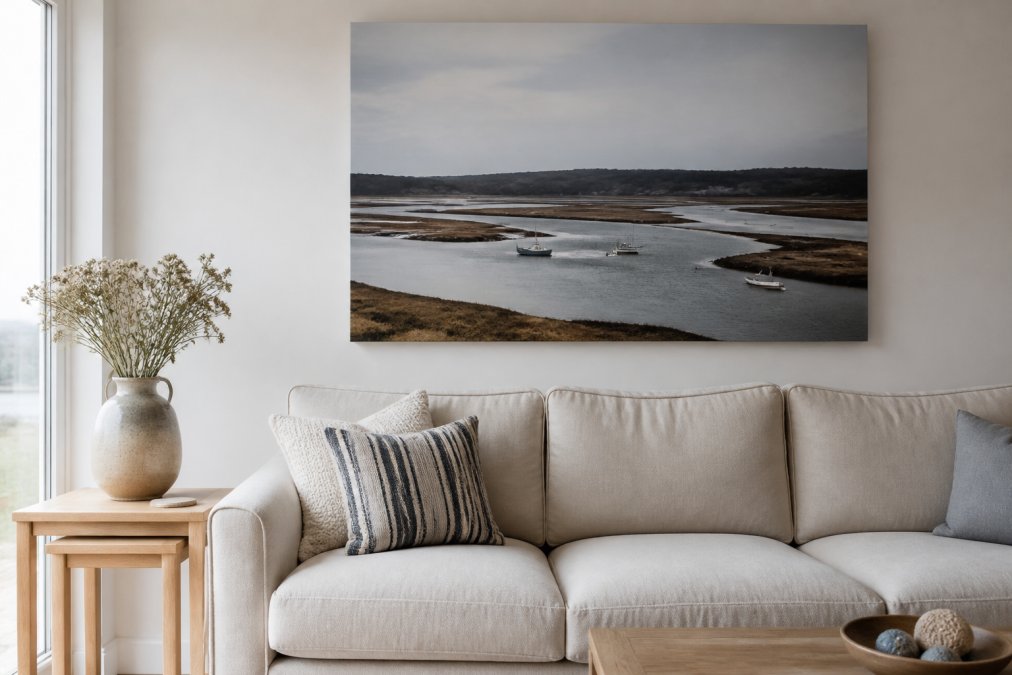
How to choose wall art for living room layouts starts with measuring the wall space accurately. A piece that is too small looks lost above a large sofa, while an oversized print can overwhelm a narrow wall.
Follow the two-thirds rule: the artwork width should be roughly two-thirds the width of the sofa or console below it. For a 2-metre three-seater sofa, a single print or canvas of 120 to 150 centimetres wide works well.
The centre of the artwork should sit at eye level, around 145 to 150 centimetres from the floor. When arranging multiple pieces, treat them as a single unit and measure the total width, including gaps, before putting any nails in the wall.
Gallery Walls and Arrangement Ideas That Feel Curated
A gallery wall is the most flexible way to build a coastal narrative, but it requires discipline. Unify the frames with the same colour wood or metal finish while varying the sizes and orientations of the prints.
Lay the arrangement out on the floor first. Place the largest piece slightly off-centre, then build outward with smaller works, keeping gaps even at 5 to 8 centimetres.
For a more relaxed feel, lean frames on a mantelpiece or console rather than hanging them. This allows you to swap pieces seasonally and adds an informal, collected-over-time quality.
Art Placement and Lighting: Making the Piece Work After Dark
Art placement and lighting determine whether your coastal wall art is visible in the evening. Without dedicated lighting, a piece can disappear against a dark wall or be washed out by a ceiling light.
Picture lights mounted above the frame provide a warm, focused glow that mimics daylight. Adjustable track lighting or a floor-standing spotlight creates a gallery-like atmosphere without rewiring.
Bulb colour temperature matters. Warm white bulbs around 2700K to 3000K flatter the sandy and neutral tones of coastal art, while cooler daylight bulbs make the same piece look stark and blue (energy.gov).
Sustainable Coastal Art and What to Ignore When Shopping
Sustainable coastal art is a growing priority, and print-on-demand production now allows for high-quality pieces without mass overproduction. Look for providers who print to order, use archival inks, and source frames from certified sustainable wood.
What to ignore is equally important. Heavily discounted mass-produced prints often use low-grade inks that fade quickly and non-sustainable materials. Be wary of generic listings that do not disclose the printing process or material origin.
According to guidance on sustainable decorating from the UK Green Building Council, choosing durable, high-quality materials over disposable decor is one of the most effective ways to reduce the environmental impact of your home. Supporting independent artists who produce locally or in small batches also ensures your piece is unique and that your money goes toward original design work rather than factory replication.
Bringing the Coast Home with Intention
The most successful coastal interiors feel calm because every element earns its place. Start with a single piece that genuinely moves you, then build the room around its palette and mood.
For original designs rooted in a specific sense of place, Drift and Cast creates premium, print-on-demand coastal art inspired by the fishing culture and tidal landscapes.
Get started with Drift and Cast and bring the wild, salt-aired spirit of the coast into your living room.
Frequently Asked Questions
What art looks good in a living room with a coastal theme?
For a coastal living room, choose art that captures the sea's atmosphere without relying on clichés. Seascapes, ocean photography, and abstract pieces in neutral palettes work well. Look for prints that focus on texture, light, and mood rather than literal beach scenes with sunsets. A large canvas of rough sea or a series of small framed studies of coastal landscapes can anchor the space. Mixing a statement piece with quieter, tonal artworks creates a curated feel.
Should coastal wall art be framed or canvas?
Both work, but the choice changes the feel. Framed prints with a mat board feel more refined and gallery-like, which suits traditional or modern interiors. Canvas prints offer a softer, more casual look and work well for large statement pieces without glass glare. For a coastal palette, consider light oak or whitewashed frames. Canvas is often lighter to hang, while framed pieces protect the paper better over time. Match the option to your room's existing furniture and lighting.
What size art is best for a coastal living room wall?
A single large piece should measure roughly two-thirds to three-quarters of your sofa's width. For a standard three-seater around 200 cm wide, that means a print or canvas of about 120-150 cm wide. Above a fireplace, aim for a piece that spans about half the mantel's width. For gallery walls, map the arrangement on paper first. Avoid hanging small pieces alone on large, empty walls, as they tend to look lost.
How do I choose wall art for a modern coastal living room without it looking kitsch?
Stick to a restrained palette of off-whites, soft greys, and muted blues, and avoid literal motifs like anchors or shells. Look for art that hints at the coast through texture, light, or abstract shapes rather than obvious symbols. A single high-quality seascape or a set of tonal prints feels more considered than many small beach-themed trinkets. Balance the wall art with natural materials like linen and oak so the room feels cohesive, not themed.