
Fishing Themed Art for Office: 7 Best Picks for 2026
Table of Contents
- Types of Fishing Themed Art for Office Walls
- Is High End Fly Fishing Home Decor Worth the Price?
- How to Style a Fishing Themed Office
- Coastal Office Decor Ideas That Work in Small Spaces
- Canvas Prints vs Framed Art: What Suits a Professional Workspace?
- Custom and Handmade Fishing Decor Worth Considering
- Sustainable and Eco-Friendly Art for the Conscious Angler
- Frequently Asked Questions
Last Updated: September 20, 2026
Types of Fishing Themed Art for Office Walls
Fishing themed art for office walls draws on angling, coastal landscapes and marine life to bring character to a professional workspace. This guide from Drift and Cast covers the main categories, what they cost, and how to choose pieces for the room you actually work in.
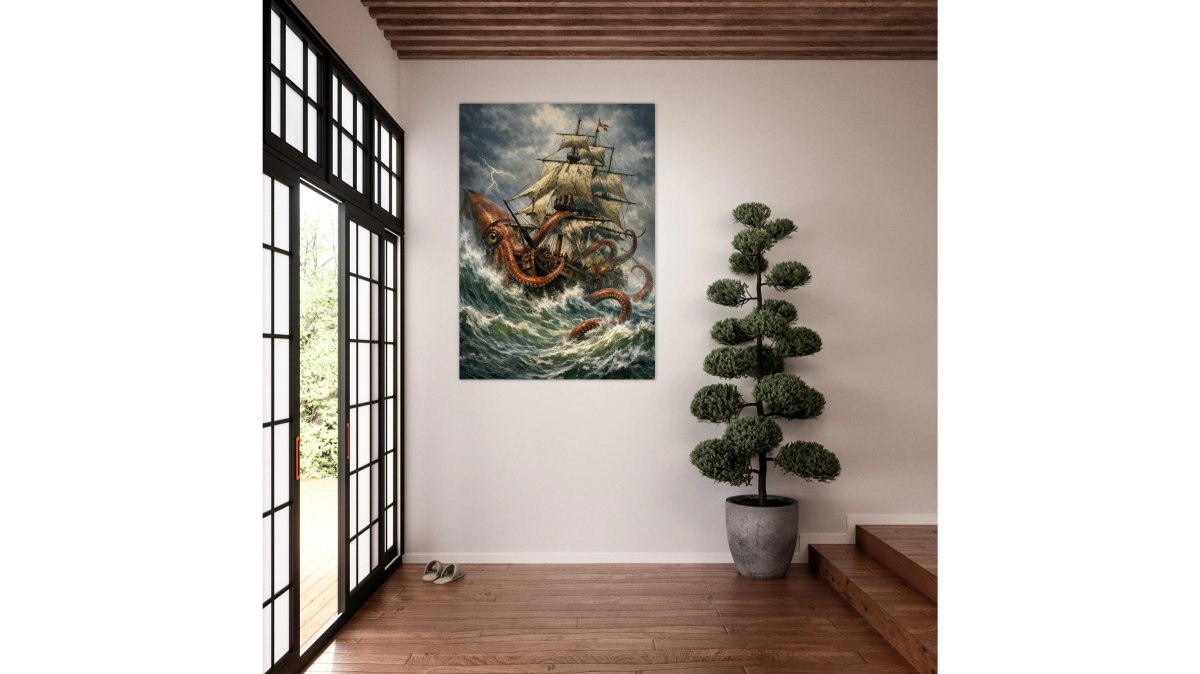
The categories matter because they behave differently on a wall. A muted archival landscape recedes and calms. A bold semi-glossy character print pulls the eye the moment someone walks in. Neither is wrong; they simply do different jobs.

Broadly, office-appropriate fishing art falls into four groups:
- Landscape and seascape prints, harbour scenes, estuaries, headlands, sunrise over open water
- Character and narrative pieces, sea monsters, trophy catches, humour with a fishing bent
- Coastal abstracts and texture studies, rope, boat hulls, weathered timber, water surfaces
- Functional decor, mugs, enamel cups and desk items that carry the theme without filling wall space
The psychology is straightforward and often overlooked. Biophilic design, putting natural references into built environments, is widely used in workplace planning because nature imagery gives the eye somewhere restful to land. A fishing print does that while saying something about you.
Is High End Fly Fishing Home Decor Worth the Price?
It is worth the price when the piece sits in a room you use daily and the print quality holds up over years, not for a corridor you walk past twice a day.
How to Style a Fishing Themed Office
Styling works best when the art is one element in a room, not the whole room. Pick a focal point, build a restrained palette around it, then stop. The part most guides skip is where the art goes relative to how you work.
Where to hang art relative to your desk
The wall you face is not automatically the right wall. Consider three sightlines:
- The seated sightline. A single anchor piece centred slightly above eye level when seated is the most restful arrangement. Hanging it too high forces you to crane and reads as an afterthought.
- The doorway sightline. What does a visitor see first? If the door opens onto a blank wall, that wall earns the anchor piece, not the wall behind your monitor.
- The camera sightline. On video calls, the wall behind you is your background. A busy gallery wall is distracting; one or two restrained pieces, or a single large print, reads as considered. Avoid hanging art directly behind your head where the frame crops it awkwardly.
Lighting
Art hung opposite a window is lit evenly for most of the day; art on the same wall as the window sits in its own shadow. With no natural light, a small picture light or warm LED spot angled across the surface does more than any frame upgrade.
Curating a themed gallery wall
A fishing gallery wall works when it tells a story rather than repeating one. The most convincing arrangements mix three or four types of piece:
- An anchor piece, the largest print, ideally a landscape or seascape that sets the palette.
- A vintage-style map or chart, a coastal chart or estuary map adds a documentary layer and a different texture.
- A character or narrative print, a sea monster, a trophy catch or a humorous piece stops the wall feeling like a museum.
- A smaller detail piece, a rope study, a boat hull, a water surface abstract, or a shellfish print.
A practical sequence
- Choose the wall you face most often and make that the focal point
- Pick one anchor piece, ideally the largest print you can afford
- Add one or two smaller pieces at 60-70% of the anchor's width
- Hang the centre of the arrangement at eye level when seated
- Leave at least 5 cm between frames so each piece reads separately
- Match frame finish across the group, even if the art differs
Coastal Office Decor Ideas That Work in Small Spaces
Small rooms reward restraint. One well-chosen coastal print beats four competing ones, and vertical pieces use wall height furniture cannot.
- A single tall print in a slim frame, hung to the side of the desk rather than behind it
- A gallery wall of three small prints in a tight grid instead of a wide spread
- A nautical-themed desk object, such as Drift and Cast's Lizard Tuna ceramic mug at £14.99, which is dishwasher and microwave safe and reads as considered rather than themed
- A warm neutral wall so the art carries the colour
Canvas Prints vs Framed Art: What Suits a Professional Workspace?
The decision is less about the substrate than about what sits between the print and the room.

| Factor | Framed Art | Canvas Prints |
|---|---|---|
| Protection | Glass or acrylic shields the print from dust, fingers and airborne oils | Exposed surface, dust settles into the weave |
| Weight | Heavier, needs a solid fixing into masonry or a stud | Light, hangs on a single hook |
| Finish | Formal, gallery-like | Softer, more casual |
| Reflections | Glare unless anti-reflective glazing is specified | No glare |
| Cleaning | Wipe the glazing only, never the print | Dust with a dry, soft brush |
| Best for | Client-facing and executive offices | Home offices, relaxed spaces |
Glazing: the decision most guides skip
For anything archival or limited edition, specify UV-filtering glazing. UV light fades pigment inks, and a south-facing wall can do more damage in a year than a decade in a shaded corridor.
Winter Fishing - Mullion Cove, Lizard →
Mounting and backing
Paper prints need an acid-free mount board so the paper never touches the glazing; without one, condensation forms inside the glass and the print can stick permanently. A frame with a mat board, or at minimum a spacer, is the correct specification. Foam-core backing is adequate; acid-free backing board is better for anything you keep for years.
Hanging hardware for UK walls
Most homes and offices have plasterboard over timber studs or dot-and-dab adhesive. A framed print over roughly 2 kg should go into a stud or a hollow-wall fixing rated for the load, not a single pin. Canvas is forgiving because it is light, but a wide canvas still needs two fixings to stop it swinging. Picture hanging systems with a rail and adjustable hooks avoid repeated holes if you expect to rearrange the wall.
When canvas genuinely wins
Canvas is the better choice when the wall is large, the budget tight, or the room relaxed rather than client-facing, and in rooms with strong directional light, since there is no glazing to reflect it. The trade-off: canvas cannot be re-framed later, and a canvas that sags or creases is hard to correct.
A note on matching across a group
Paper prints, including the semi-glossy 170 gsm stock used across the Drift and Cast range, are built for framing. For a cohesive group, pick one substrate and vary the size.
Custom and Handmade Fishing Decor Worth Considering
Custom and handmade pieces earn their place when the subject means something specific to you. A generic coastal print is decor; a print of the headland where you actually fish is a conversation.
Sustainable and Eco-Friendly Art for the Conscious Angler
Print-on-demand is the most meaningful sustainability lever in wall art: nothing is produced until someone orders it, removing the overstock that ends up discounted or binned.
Look for three things on any listing:
- FSC-certified paper, which confirms the fibre comes from responsibly managed forests
- Acid-free, archival stock, which keeps the print out of landfill for longer
- Print-on-demand production, which avoids speculative overproduction
Frequently Asked Questions
How do I choose fishing-themed art that looks professional?
Stick to muted colour palettes, archival paper and simple frames. A 250 gsm acid-free print like the Winter Fishing at Mullion Cove archival print (£17.99) reads as fine art photography rather than novelty decor, which suits client-facing rooms. Avoid cartoonish designs in shared spaces and keep the frame consistent with your desk finish. One strong focal point beats five busy prints.
What are the best types of fishing art for a small home office?
Small rooms need fewer, larger pieces. A single semi-glossy print, such as Fishing at Trefussis Point (£14.99), fills a narrow wall without crowding it. If you want variety, use a two or three-piece multi-panel arrangement on one wall only. Keep scale in mind: a print that is too small will look lost, and one that is too large will dominate the room.
Is high end fly fishing home decor worth the price?
It depends on what you are paying for. Archival, acid-free paper (pH 7+) resists yellowing, so a £17.99 print can outlast a cheaper poster by years. FSC-certified stock and print-on-demand production also reduce waste. If the piece will hang in a workspace you use daily, the cost per year is small. If it is a temporary fix, a lower-priced option makes more sense.
Where can I find authentic, Cornwall-inspired fishing art?
Look for prints made from original photography or artwork of named locations, not generic stock imagery. Drift and Cast, for example, produces prints of Mullion Cove, Falmouth and Trefussis Point on FSC-certified paper, available in 29 sizes. Buying direct from a Cornwall-inspired brand also means you can ask about the source of the artwork before you commit.
How can I incorporate coastal heritage into my workspace decor?
Start with one anchor piece that references a real place, then build around it. Add texture through a woven mat or a linen noticeboard, and repeat one accent colour from the print in small doses. A vintage-style map or a harbour scene works well. Keep the rest of the desk clear so the artwork carries the theme rather than competing with clutter.