
What Makes Coastal Art Authentic: A 2026 Collector's Guide
Table of Contents
- Why Authentic Coastal Art Feels Different
- Artist Intent: The Line Between Authentic Coastal Art and Decoration
- Materials and Mediums That Signal Genuine Coastal Art
- Authentication and Provenance: The Questions Mass-Produced Prints Can't Answer
- The Benefits of Original Maritime Paintings Over Decorative Prints
- Choosing High-End Coastal Wall Art for Your Home
- How to Style Coastal Home Decor Without Losing the Authentic Feel
- Conclusion
- Frequently Asked Questions
Last Updated: September 27, 2026
Why Authentic Coastal Art Feels Different
What makes coastal art authentic is that it is created by an identifiable artist, from a real place and moment, using materials that hold their quality over time. At Drift and Cast, we work from original photography of specific stretches of the Cornish shoreline: tidal estuaries, working lifeboat stations, granite coves, the difference between a picture of "the sea" and a picture of somewhere you have stood.
Most coastal decor is generic, produced in volume for buyers with no particular connection to any coastline.
Artist Intent: The Line Between Authentic Coastal Art and Decoration
The clearest test of what makes coastal art authentic is intent. An artist working from a real shoreline records something specific: the way light hits serpentine rock at Kynance Cove, the grey of an Atlantic sky before rain. A decor manufacturer produces something that matches a colour scheme.

How to Read Brushwork, Composition and Visual Depth
Look at where the artist wants your eye to go. Strong coastal work has a clear focal point and genuine visual depth: foreground texture, a mid-ground subject, and distance that recedes convincingly. Weak work flattens everything into one plane of pleasant colour.
Materials and Mediums That Signal Genuine Coastal Art
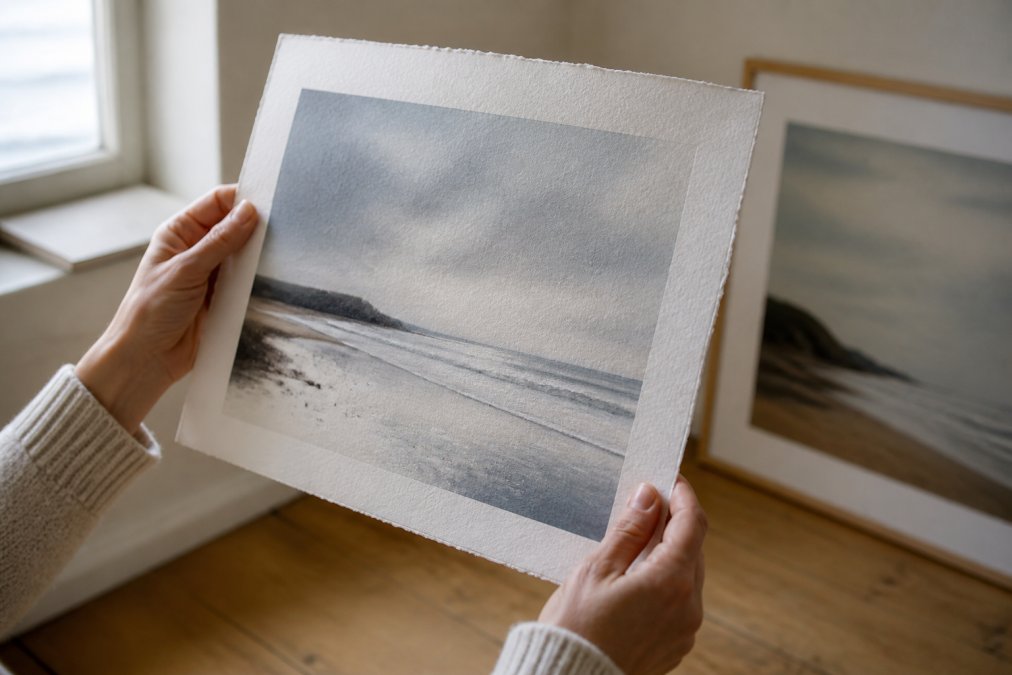
Materials are where authenticity becomes measurable. A print on thin, bright-white glossy paper looks sharp for a year and tired for the rest of its life. Archival materials resist fading and yellowing over decades.
Archival Quality, Pigment and Material Longevity
Archival quality is not a marketing word, it maps to checkable properties, chiefly the pH of the paper and the chemistry of the ink.
- Glazing with UV filtering. Standard glass blocks almost no UV; UV-filtering glass or acrylic blocks the majority of it. This is the single biggest variable in how long a print survives on a bright wall.
- A mount (mat) between artwork and glazing. This keeps the print off the glass, allows air circulation, and prevents condensation transferring onto the surface.
- Acid-free mount board and backing. Cheap mount board is a common cause of 'foxing', the brown spotting that appears on prints after a few years.
Why Coastal Homes Are a Hostile Environment for Art
A coastal property adds two stressors inland buyers rarely think about: salt-laden air and higher average humidity.
Practical responses that actually work:
- Keep artwork off external walls where condensation is most likely, and away from kitchens and bathrooms where humidity spikes.
- Avoid hanging directly above radiators or in the path of a strong south-facing window, where heat and UV combine.
- If a room is persistently damp, a small dehumidifier does more for the artwork than any frame upgrade.
- For very exposed locations, consider a sealed frame with a backing board rather than an open-backed one.
Authentication and Provenance: The Questions Mass-Produced Prints Can't Answer
Provenance is the documented history of a piece: who made it, where, when, and how it reached you. Decorative print sellers cannot participate in it, because there is nothing to document.
The Benefits of Original Maritime Paintings Over Decorative Prints
Original maritime paintings and photographic prints hold value decorative reproductions cannot: uniqueness, a direct line to the maker, and materials chosen for longevity rather than margin. An original is a single object, and that changes how you live with it.
| Option | Typical Paper and Ink | Lifespan in a Bright Room | Provenance |
|---|---|---|---|
| Mass-produced decor print | Thin coated stock, dye ink | Fades noticeably within a few years | None |
| Fine art print from an original image | 200 gsm matte, pigment or giclée ink | Holds colour for decades if framed well | Named maker and location |
| Original painting or relief print | Artist's chosen ground and medium | Outlasts the buyer if cared for | Full, documented |
Choosing High-End Coastal Wall Art for Your Home
Choosing high-end coastal wall art comes down to four checks: the maker is named, the place is named, the materials are stated, and the size suits the wall. Get those right and you will rarely regret a purchase.
Sunset Poster from Loe Bar, Lizard →
Work through this before you buy:
- Confirm the maker. A studio name, an artist name, or a documented original photograph. Anonymous is a red flag.
- Confirm the place. The title should name a real location, not "Ocean View" or "Blue Coast."
- Confirm the materials. Paper weight, finish, and ink type. Matte finishes suit coastal work because they avoid glare and let natural textures read.
- Confirm the size against the wall. Measure the wall, not the frame you already own. A print that is too small for a large wall reads as an afterthought.
- Confirm the finish suits the room. Semi-glossy stock lifts colour in darker rooms; matte stock suits bright, sunlit spaces.
How to Style Coastal Home Decor Without Losing the Authentic Feel
Styling coastal home decor well means restraint. The fastest way to make authentic art look cheap is to surround it with themed props: netting, shells, model boats, and a dozen matching blue cushions.
Getting the Scale and Height Right
Most styling failures are measurement failures, not taste failures. Two rules fix the majority:
- Artwork should occupy roughly two-thirds to three-quarters of the width of the furniture below it. A sofa 200 cm wide wants a piece (or grouping) around 140-150 cm across. A print that is too small for a large wall reads as an afterthought; one that crowds the edges reads as a poster.
- Hang at eye level. The centre of the artwork should sit around 145-150 cm from the floor in a room where people stand, and lower, closer to 120-130 cm, above a sofa or bed where people sit. Galleries use similar figures, which is why their hangs feel effortless.
Room by Room
Living room. A single larger anchor piece earns its keep here. A muted seascape or harbour scene in a simple timber or slim black frame sits comfortably above a sofa without competing with a television. Keep cushions and throws in the same soft palette, sand, chalk white, driftwood grey, so the artwork's colour is the loudest thing in the room.
Choosing the Frame
Match the frame to the room, not the theme. A simple timber or slim black frame suits almost everything. Ornate gilt fights coastal work. White frames disappear into pale walls and let the image dominate; black frames add a graphic edge that suits high-contrast photography and relief prints.
The Authenticity Test
Here is the styling rule that ties back to everything above: if you removed the artwork, would the room still look coastal? If yes, because of the shells, the rope, the blue-and-white stripes, then the art is decoration, not the anchor. Authentic styling works the other way round: the room is neutral, the art is the coastal reference. That is what makes a named location on the wall feel like a window rather than a theme.
Conclusion
The gap between authentic coastal art and coastal-themed decoration is not snobbery, it is documentation. A named place, a named maker, and materials built to last separate a piece you keep from a piece you replace.
Frequently Asked Questions
How can you tell if coastal art is high quality?
Look at the paper weight, print method and finish. Archival giclée printing uses pigment-based inks that resist fading, while premium matte papers around 200 gsm hold colour depth without glare. Check whether the piece is hand-signed, part of a limited edition, or printed on FSC-certified stock. A genuine coastal art print will also show real tonal range in the sky and water, not flat, over-saturated colour. Ask the seller where the image was captured and whether it comes from original photography or painting.
Does coastal art need to be original to be authentic?
No. Authenticity comes from intent, provenance and material quality, not from whether the piece is a one-off. A hand-signed limited edition giclée print made from an artist's own photograph of a specific stretch of coastline carries the same authenticity as an original painting. What separates authentic coastal art from mass-produced decor is that the image comes from a real place, the artist can name it, and the materials are chosen to last. Limited edition prints and fine art photography both qualify.
What materials are typically used in authentic coastal wall art?
Authentic coastal art tends to use archival-grade materials: 200 gsm or heavier matte paper, pigment-based giclée inks, FSC-certified stock, and sometimes canvas or wood panel for originals. Original works may involve oil, acrylic, watercolour, mixed media, lino cuts or woodcuts. The common thread is longevity. If a print uses lightweight paper and dye-based inks, it will fade within a few years in direct light. Archival materials are designed to hold their colour for decades.
Is mass-produced beach decor considered authentic?
Generally, no. Mass-produced beach decor is designed for volume, not for a specific place or moment. It often relies on generic motifs like anchors, seagulls and striped lighthouses that don't reference any real coastline. Authentic coastal art is tied to a location, a light condition or a memory. That connection is what gives it weight on a wall. If the same print appears in thousands of identical listings with no named source, it lacks the provenance that defines authentic coastal art.