
Is Coastal Decor Still Trendy in 2026? A Modern Guide
Table of Contents
- Is Coastal Decor Still Trendy in 2026?
- Modern Coastal Decor Ideas for 2026
- Coastal Colour Schemes That Feel Fresh
- Coastal Living Room Ideas: Balancing Breezy Comfort with Sophistication
- Outdated Coastal Decor to Avoid (and How to Modernise It)
- Room-by-Room Updates Beyond the Living Room
- Budget Tiers, Sourcing, and Sustainable Choices
- Frequently Asked Questions
Last Updated: October 13, 2026
Is Coastal Decor Still Trendy in 2026?
Yes, coastal decor is still trendy in 2026, but it looks nothing like the beach-themed rooms of a decade ago. The look has grown up.
At Drift and Cast, we design Cornwall-inspired wall art and home pieces for people who love the shoreline, so we follow this shift closely. The mood now is quiet and lived-in, not themed.
Here is the short answer: coastal style did not fade. It matured into something closer to modern cottage and Hamptons style, with softer colour and better materials.
Modern Coastal Decor Ideas for 2026
Modern coastal decor ideas for 2026 centre on texture, warmth and restraint. The goal is a room that feels calm and lived-in, not one that looks like a holiday let.
Three shifts define the look:
- Warmth over cool. Swap icy grey-blue for sand, clay and oatmeal tones.
- Fewer, better pieces. One strong artwork beats ten small ornaments.
- Real materials. Linen, oak, rattan and stone age well. Plastic does not.
Warm Neutrals and Natural, Organic Tones
Warm neutrals are the backbone of the 2026 coastal palette. Think soft whites, creams, oatmeal, sand and mushroom, layered with muted blues and soft greys.
The trick is mixing temperatures. All-cool rooms read cold and flat. Add one warm tone, such as a clay cushion or a natural oak frame, and the whole space settles.
Organic Shapes and Fluid Forms
Organic shapes and fluid forms keep coastal rooms from feeling boxy. Curved sofas, rounded mirrors and wavy ceramic vases echo the coastline without shouting about it.
Pick two or three curved pieces per room, then keep everything else clean and simple. Too many curves turns calm into chaotic.
Coastal Colour Schemes That Feel Fresh
Coastal colour schemes that feel fresh in 2026 combine soft whites and creams with pale aqua, muted blues and gentle greys. The palette stays light and airy, but it is warmer and more layered than the old blue-and-white formula.
A simple ratio works well:
- 60% soft whites and creams
- 30% muted blues, pale aqua or soft greys
- 10% a deeper accent, such as moody navy or olive
Soft Whites, Creams, and Pale Aqua
Soft whites and creams form the base. Pale aqua and muted blues add the sea reference without turning the room into a theme.
Keep deeper moody tones for small accents: a cushion, a lamp base, a frame. They add depth and stop the room reading washed out. Reflective tones on glass and metal bounce natural light around, which keeps small rooms feeling open.
Coastal Living Room Ideas: Balancing Breezy Comfort with Sophistication
Coastal living room ideas work best when breezy comfort meets sophistication. That balance is the whole game: relaxed enough to sink into, polished enough to feel considered.
Start with one anchor piece, such as a linen sofa in cream or oatmeal. Add natural materials like a driftwood coffee table or a jute rug.
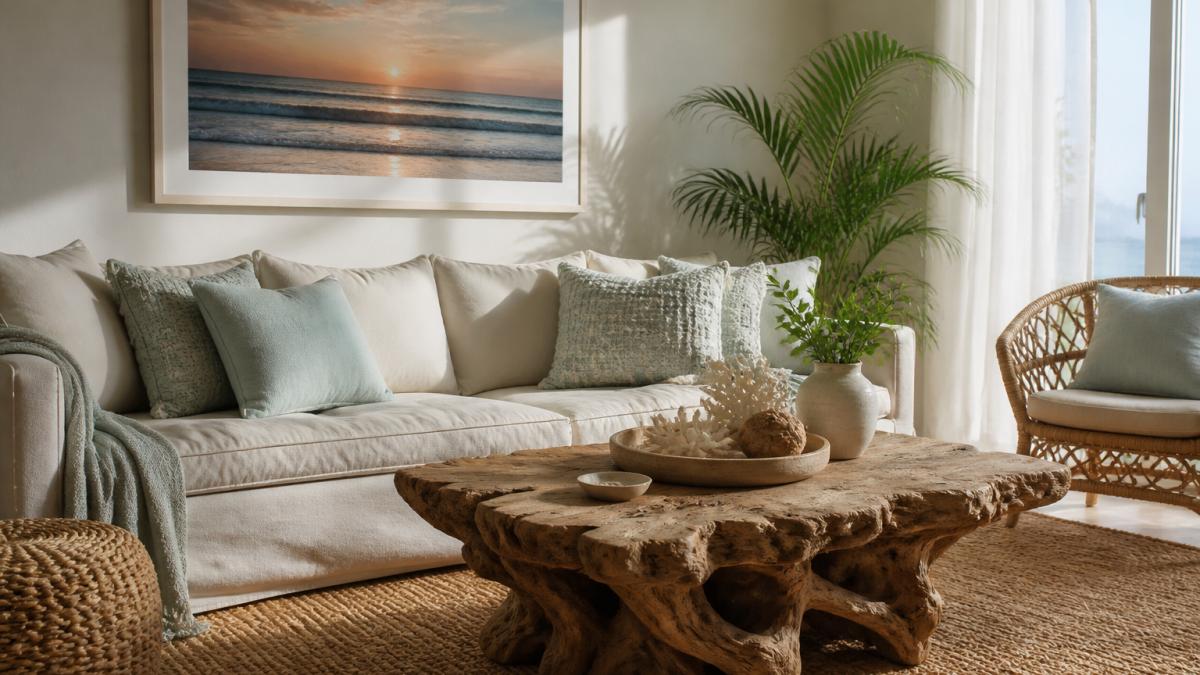
For a lighter, more affordable option, the Gwithian Sunset art print starts at £14.99 and comes in 29 sizes. If you want movement rather than stillness, the Falmouth Bay Waves print brings the energy of a running swell.


Hang art at eye level, roughly 145 to 150 cm from the floor to the centre of the frame. One large piece usually beats a gallery wall in a calm coastal room.
Mullion Cove Sunset – Framed Cornwall Wall Art →
Outdated Coastal Decor to Avoid (and How to Modernise It)
Outdated coastal decor is easy to spot once you know the signs. The good news is that most of it can be fixed without a full redecorate. The trick is to work in a sequence, so each change builds on the last rather than fighting it.
The five dated elements to look for
| Outdated element | Why it dates the room | Modern fix |
|---|---|---|
| Nautical stripes everywhere | Reads as a theme, not a home | Keep one striped piece, drop the rest |
| Novelty seashell ornaments | Clutters surfaces | One natural shell or ceramic bowl |
| Cool grey-blue walls | Feels cold and flat | Repaint in warm cream or sand |
| Matching furniture sets | Looks showroom-staged | Mix wood tones and eras |
| Plastic coastal signs | Cheapens the palette | Swap for framed real photography |
A common mistake is treating coastal as a colour scheme alone. It is really a feeling: light, texture, calm.
A sequenced modernisation plan
Tackling a dated coastal room in this order avoids wasted spend, because each step changes how the next one reads.
- Paint first. This is the single highest-impact change. Swap cool grey-blue walls for a warm cream, sand or oatmeal. If you rent and cannot repaint, use large removable wall panels or a fabric headboard in a warm neutral to shift the temperature instead.
- Clear the surfaces. Remove novelty ornaments, plastic signs and themed trinkets. Keep one or two sea references per room, a single natural shell, a ceramic bowl, one framed photograph. The restraint is what makes it look current.
- Swap the textiles. Replace synthetic throws and shiny cushions with linen, cotton and wool in oatmeal, clay and muted blue. Textiles are the cheapest way to add warmth without touching the walls.
- Introduce one natural material. A jute rug, an oak side table or a rattan lamp base. Real materials age well; plastic does not.
- Rehang the art. Replace multiple small themed prints with one large framed piece at eye level, roughly 145 to 150 cm from the floor to the centre of the frame. One strong artwork beats a gallery wall in a calm coastal room.
- Add one deeper accent. A moody navy or olive cushion, lamp base or frame stops the room reading washed out.
What to keep
Not everything dated needs to go. Striped linen, whitewashed timber and woven baskets can all work if they are used sparingly and mixed with warmer tones. The test is simple: if a piece looks like it came from a holiday let, it is probably the wrong side of the line. If it looks like it came from a real home near the coast, keep it.
Room-by-Room Updates Beyond the Living Room
Coastal style travels well beyond the living room, and this is where most guides stop short. The same rules apply in every room: a soft base, natural texture, and one or two sea references rather than a theme. What changes is the practical constraint, moisture in a bathroom, grease in a kitchen, storage in a hallway.
Bedroom
Linen bedding in oatmeal or soft white is the anchor. Add a framed sunset or wave print above the bed, hung so the centre sits roughly 145 to 150 cm from the floor. Layer sheer curtains with a blackout lining behind them so the room still sleeps well in summer. A rattan or oak bedside table and a wool throw in clay or muted blue finish the look without clutter. If you rent, a fabric headboard in a warm neutral is a removable way to shift the palette.
Bathroom
Moisture is the constraint here, so choose materials that cope. Pale aqua or soft grey tiles work as the base, with oak or teak shelving sealed for damp. Rolled white towels, a small framed wave print in a moisture-tolerant frame, and a ceramic dish for soap keep surfaces calm. Avoid untreated wood and paper prints directly above a shower.
Kitchen
Cream or sand cabinets, a muted blue splashback, and open shelves in natural wood give the coastal feel without novelty. A driftwood or ceramic bowl on the worktop, a linen tea towel, and one framed print near the dining end are enough. Keep the sea references to two or three pieces so the room still reads as a working kitchen.
Hallway and entryway
A slim console, a round mirror to bounce light, and one large coastal print to draw the eye through. A woven basket for keys and post keeps the surface clear. In a narrow hall, hang the print on the longest wall rather than opposite the door, so it is seen on the way through rather than head-on.
Small spaces and rentals
If you cannot repaint or drill, focus on the removable layers: textiles, a leaning framed print rather than a hung one, a plug-in wall light, and a jute or cotton rug. These changes travel with you and cost far less than a redecorate.
A note on climate
In damper, saltier air, choose materials that tolerate it: sealed oak, rattan, linen blends and powder-coated metal rather than untreated iron. In brighter, south-facing rooms, deeper accents such as navy or olive hold their colour better than pale aqua, which can wash out in strong light.
Budget Tiers, Sourcing, and Sustainable Choices
Budget tiers make coastal updates manageable. You can refresh a room at almost any price point if you prioritise well.
- Under £50: new cushion covers, a jute rug, one affordable art print.
- £50 to £200: a framed print, a linen throw, a rattan lamp.
- £200 plus: a linen sofa, a solid oak coffee table, a large framed piece.
Sourcing matters too. Look for FSC-certified paper and wood, natural fibres, and print-on-demand pieces that avoid overproduction. Our own prints use FSC-certified materials and are made to order, so nothing sits in a warehouse.
Frequently Asked Questions
Is coastal decor still trendy in 2026?
Yes, coastal decor remains popular in 2026, but it has evolved. The look has moved away from obvious nautical themes and toward a more sophisticated, organic interpretation. Modern coastal style now leans on warm neutrals, natural materials, and fluid shapes rather than anchors and striped cushions. The focus is on creating peaceful, lived-in spaces that feel connected to the coast without being literal about it.
What colours are popular in coastal interiors right now?
Coastal colour schemes in 2026 favour soft whites, creams, and warm neutrals as a base, layered with muted blues, pale aqua, and soft greys. Moody tones like deep ocean blue or slate are used sparingly for contrast. The palette feels calm and reflective rather than bright and primary, which helps rooms stay restful and sophisticated throughout the year.
How can I make coastal decor look modern instead of dated?
Start by removing obvious nautical props like anchors, ship wheels, and themed novelty signs. Replace them with abstract or photographic coastal wall art, organic ceramics, and textured throws. Choose furniture with clean lines and natural materials such as oak or rattan. Keep the palette restrained, and let one or two statement pieces carry the coastal reference rather than scattering it everywhere.
What coastal wall art works best for a living room?
For living rooms, large-format prints or framed photographs of specific coastal landscapes work better than generic beach scenes. Look for pieces with muted, atmospheric colours that tie into your existing scheme. A framed sunset over a harbour or a wave study in deep blue can anchor a room without overwhelming it. Choose FSC-certified prints where possible to align with sustainable values.
Refreshing a coastal room is less about buying more and more about choosing better. If you want art that captures a real place rather than a generic seaside scene, Drift and Cast can help. Our framed and unframed prints use FSC-certified materials, come in up to 29 sizes, and are printed on demand from original coastal photography. Get started with Drift and Cast and bring the calm of the shoreline into your home.